

Leasing costs for trucks, trailers, and RV equipment are expected to rise in the first half of 2026 due to increased tariffs and potential interest rate cuts from the Federal Reserve.
According to Equipment Finance News’ Equipment Pricing Index and Forecast, leasing and rental prices are projected to improve in 2026, based on data from the U.S. Bureau of Labor Statistics and the Chicago Mercantile Exchange. The index for truck, trailer, and RV lease prices is expected to reach 135.6 by August 2026, representing a 3.1% increase year-on-year, while the rental forecast will be 124.3 by August 2026, marking a 1.9% YoY rise.
Index & Forecast: Truck, Trailer, and RV Pricing
Forecast Source: Equipment Finance News
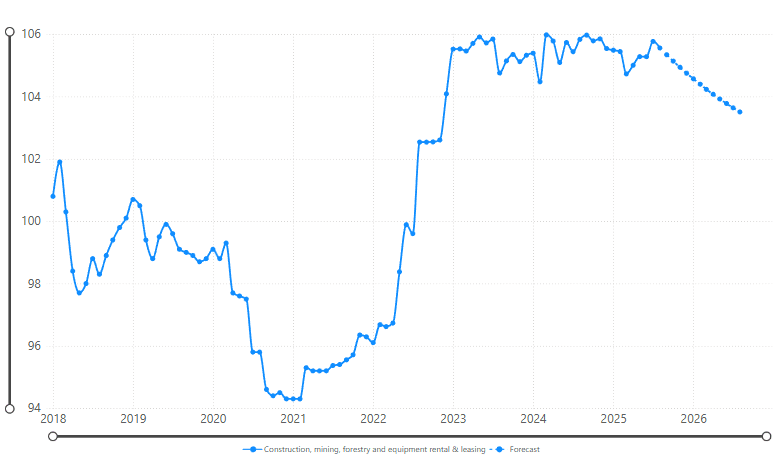
On the other hand, rental and leasing rates for construction, mining, and forestry equipment are anticipated to decline. The pricing index for this segment is forecasted at 103.5, a 1.9% decrease YoY, through August 2026, with a steady decline expected during this period according to the EFN data.
Index & Forecast: Rental and Leasing Pricing for Equipment and Trucks, Trailers, and RVs
Forecast Source: Equipment Finance News
Market Conditions
From April to August, OEM Komatsu experienced a 40% price increase in the U.S., although this rise was slightly less than anticipated, as explained by Kiyoshi Hishinuma, an executive at Komatsu, during the company’s earnings call on October 29.
Komatsu initiated a significant price hike in August. In contrast, competitors had already raised prices by double digits in 2022 and 2023, starting to lower them in the latter half of 2024, during which Komatsu did not match their price increases at the same pace.
During that time, Komatsu did not increase prices much, suggesting that there was potential for future increases, which is why the August adjustment was made.
Due to favorable market conditions, Komatsu has revised its sales outlook for the U.S. construction market upward, projecting a strengthening demand.
In late August and September, business spending and capital expenditures saw a slight decline due to weaker investment expectations and reduced demand in truck transportation, even as freight rates experienced modest increases, according to the Federal Reserve’s October 15 Beige Book.
One trucking industry contact described the current environment as ‘recession-like,’ noting that retail inventories were low, vehicle stocks were insufficient, and manufacturing inventories were somewhat elevated.
The coverage area of the Chicago Fed includes parts of Iowa, Illinois, Indiana, Michigan, and Wisconsin, including major cities like Chicago, Detroit, Indianapolis, and Milwaukee.
For exclusive industry data, check out our insights here.
