


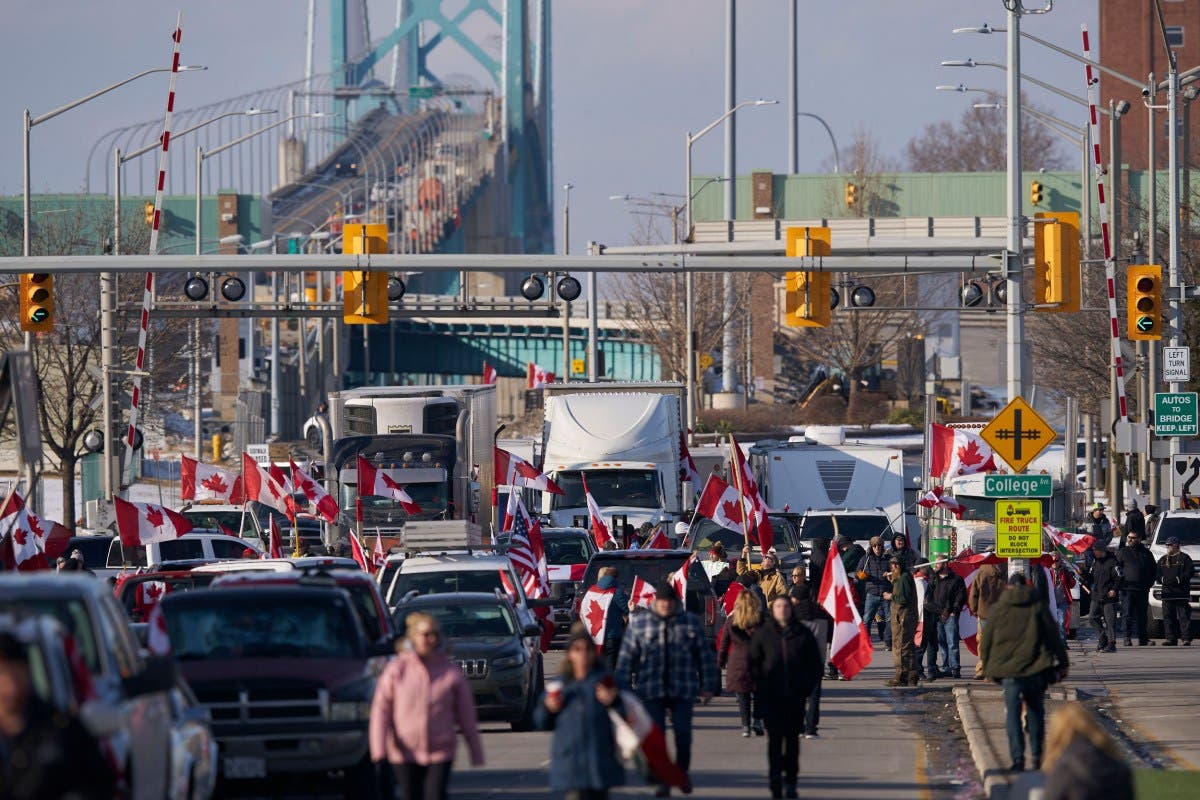
Protesters opposing COVID mandates have blocked multiple U.S.-Canada border crossings, resulting in significant economic repercussions for both countries, with losses exceeding a billion dollars for each day the blockades persist.
According to Arthur Wheaton, director of labor studies at Cornell’s School of Industrial and Labor Relations, “It’s over a billion dollars a day in goods and services that goes across the Canadian border.” He emphasized that such disruptions can lead to cumulative losses in the tens to hundreds of billions of dollars quickly.
Wheaton added that “the total value for some of these car companies” indicates that losses could exceed the entire worth of General Motors in just a few months.
Canadian truckers have extended their protests, which have been ongoing in Ottawa for two weeks, to the Ambassador Bridge connecting Detroit and Windsor, Ontario. This move has severely impacted a significant supply route into Michigan, where the auto industry feels the brunt of the blockade.
Earlier this week, both Toyota and Ford suspended production due to the ongoing protests. Michigan Governor Gretchen Whitmer has urged the Canadian government to address the situation for the sake of “working families who are just trying to do their job.”
The U.S. and Canada trade over $511 billion annually, with road transport accounting for more than two-thirds of that. Notably, the Ambassador Bridge alone handles $323 million worth of goods each day.
The Biden administration is monitoring the situation closely, with economic adviser Brian Deese stating that the protests “do nothing but hurt the economy, hurt families who are just trying to make a living.” Such disruptions arrive during a particularly precarious time for the auto industry, which has only begun to stabilize post-pandemic.
While the auto industry bears the largest economic burden, Wheaton warned that other sectors like paper, lumber, and agriculture will also be affected, possibly resulting in shortages and increased prices for everyday goods, housing, and construction. The cascading impact of these blockades could strain state budgets, affecting public services like education. Ultimately, a resolution will depend on negotiations between the U.S. and Canadian governments, a complex situation that risks encouraging protests if demands are met.
