
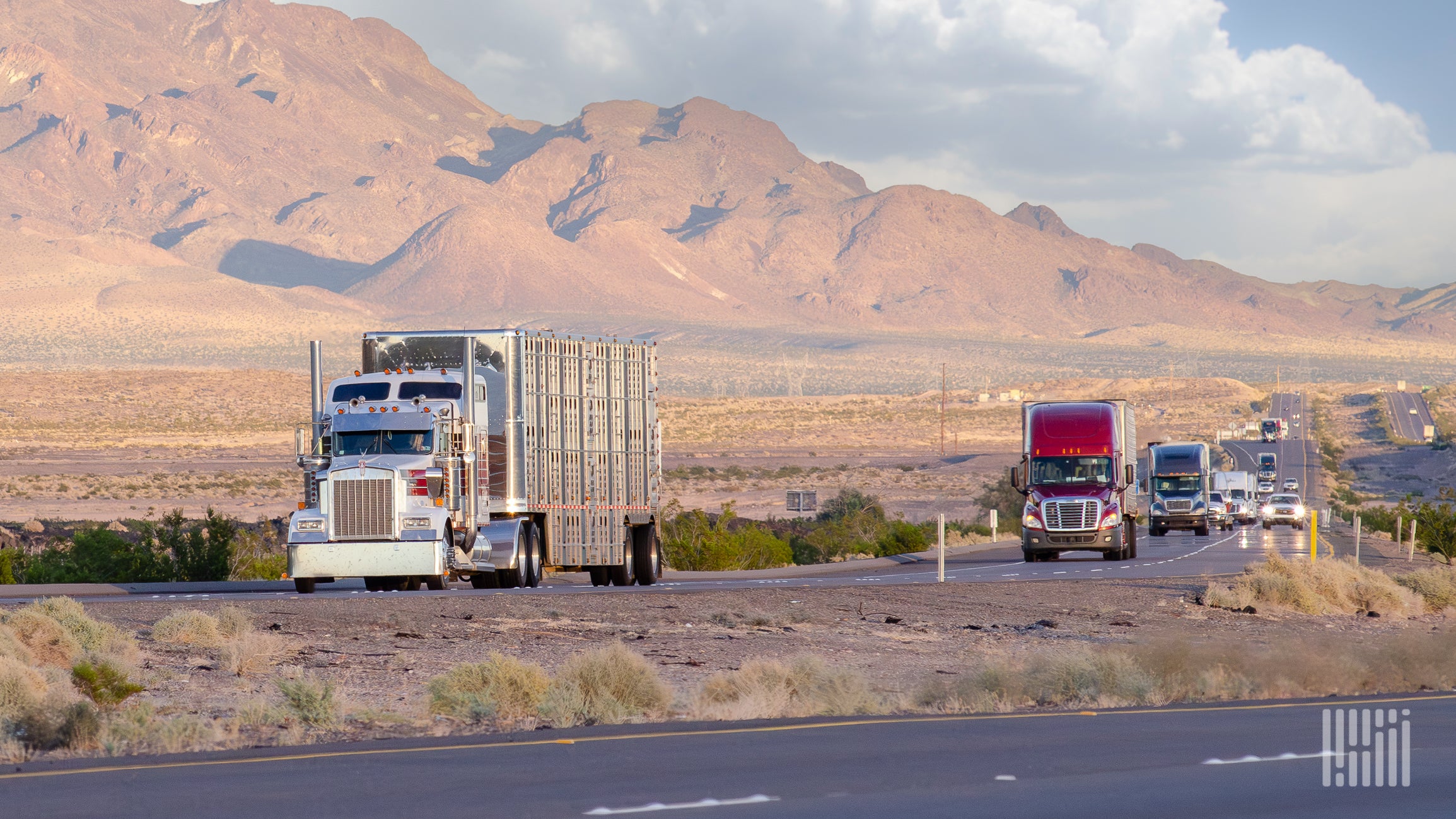
An enforcement action in California has targeted three companies—one being a carrier and the other two its clients—marking what seems to be the first instance where the state’s independent contractor law, AB5 and its successor, have led to penalties in the trucking sector.
The California Labor Commissioner’s Office stated in a release from late October that it cited these companies for misclassifying independent contractors and violating various labor laws.
The companies involved are Mega Nice Trucking, Ryder Last Mile (NYSE: R), and Costco Wholesale Corp (NASDAQ: COST), with Ryder Last Mile operating under the Supply Chain Solutions segment.
Mega Nice Trucking acted as a subcontractor for Ryder Last Mile and Costco. Labor Commissioner Lilia García-Brower mentioned that the Labor Commissioner’s Office found Ryder Last Mile and Costco exerted both direct and indirect control over the delivery drivers. They scheduled deliveries, required uniforms, enforced specific protocols, and closely monitored driver performance, establishing a joint employer relationship with Mega Nice Trucking and making both companies liable for the misclassification and ensuing wage theft.
The investigation was conducted by the Bureau of Field Enforcement (BOFE) within the Labor Department.
AB5 Enforcement Not Explicitly Mentioned
While AB5 and its amendment AB2257 are not explicitly referred to in the Labor Commissioner’s formal statement, the department confirmed in response to FreightWaves inquiries that AB5 played a role in their conclusion. The LCO reviews all misclassification cases based on the ABC test in AB5 unless an exemption applies.
Historically, before AB5 was enacted, the Borello standard was commonly used in California to determine if a worker was truly independent. While strict, Borello is generally seen as more lenient than AB5 in defining independent contractor status.
The ABC Test Explained
According to AB5, to classify a worker as an independent contractor, an employer must demonstrate that the worker:
- Is free from the control and direction of the hiring entity in performing the work.
- Conducts tasks outside the usual course of the hiring entity’s business.
- Is engaged in an independently established trade, occupation, or business related to the work.
Since AB5 took effect throughout the state in early 2020, the trucking industry experienced a delay in its application due to litigation that led to an injunction, which was lifted in mid-2022 when the Supreme Court declined to hear an appeal. The elimination of this injunction has led to the law’s full enforcement in trucking, which has now seen regulatory actions emerge.
Consequences of Misclassification
While the enforcement action marks a significant moment, sources have pointed out that it might not be the first time the state looked to AB5 guidelines in addressing misclassification. Documents from the Commission outline various violations, including minimum wage infractions, overtime violations, and failures to provide required sick leave, totaling penalties of $868,127.76—with roughly $663,000 expected to be paid to employees.
This action is currently in litigation, and the three companies are anticipated to appeal the decision. Unlike typical appeals, this scenario revolves around the state’s Labor Commissioner rather than state or federal courts, although the companies could seek those avenues later.
Trucking Industry Reaction
The California Trucking Association’s statement indicated a less dire outlook than often perceived, noting that while some owner-operators left California, others adapted their practices to comply with the law. The recent action against the three companies signifies a tangible impact of AB5 that had been anticipated in the industry.
