
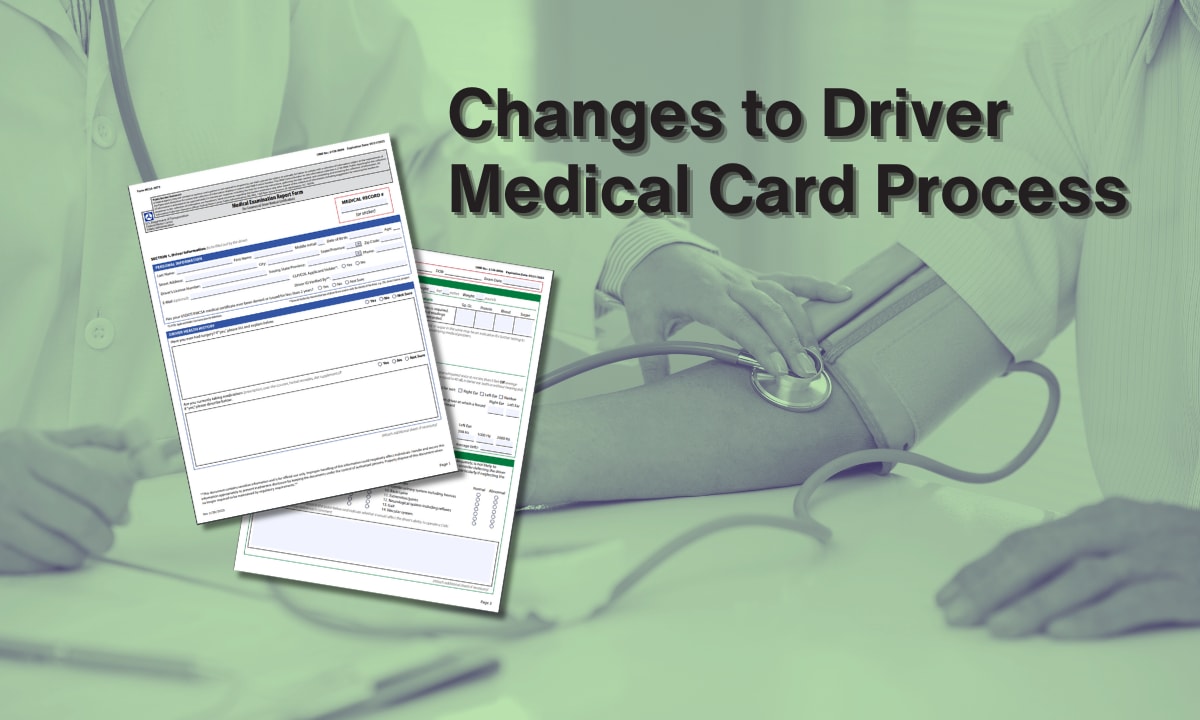
After a prolonged period of postponements, the transition to a digital system for sending commercial driver medical cards to state licensing agencies is finally underway—though this does not apply to drivers in 14 states that are still unprepared.
The Federal Motor Carrier Safety Administration’s (FMCSA) Medical Examiner’s Certification Integration rule was introduced in 2015, with an initial launch planned for 2018. Repeated delays, mainly due to IT and cybersecurity hurdles, have pushed this timeline back.
As of June 23, 2025, the new integration rules are expected to take effect. Nevertheless, some states appear not to be ready.
Update (July 14, 2025): Is there a problem with the rollout of the digital driver medical card? FMCSA provides a temporary solution.
This regulation modernizes the collection, storage, and sharing of commercial drivers’ medical certification information.
The medical certificate, commonly known as a med card, verifies that drivers meet federal requirements to operate commercial motor vehicles, based on an examination from a certified medical professional listed on the FMCSA’s National Registry of Certified Medical Examiners.
The Previous Method for Handling Commercial Driver Medical Cards
In recent years, individuals with commercial driver’s licenses were responsible for delivering a paper copy of their medical examination certificate to their respective state licensing agencies.
While medical professionals conducting those exams needed to report results to the FMCSA registry of certified examiners, this process frequently faced delays and was often incomplete, as noted by Brandon Wiseman from Trucksafe Consulting in a company article.
Simultaneously, state licensing agencies had to manually update license records, a process noted for its susceptibility to human error and paperwork delays, according to Wiseman.
Changes in the CDL Driver Med Card Process
With the new integration rules effective from June 23, 2025, drivers will no longer need to supply a paper copy of their medical exam certificate to their state licensing agency.
Certified medical examiners will now send the results of medical exams directly to the FMCSA national registry, which in turn electronically communicates these results to the state licensing agencies to update the driver’s records.
States must downgrade a driver’s commercial driver’s license or permit within 60 days if notified that the driver is no longer medically qualified or has an expired medical card. While drivers still need to self-certify their type of commercial operation, there is no longer a requirement to provide a physical copy of the medical card. The regulation remains unchanged for non-CDL drivers.
What If My State Is Not Prepared?
As of June 20, several states did not meet the June 23 deadline, according to transportation attorneys from Scopelitis, Garvin, Light, Hanson & Feary.
A complete list of states yet to implement National Registry II (NRII) is available at the base of the NRII Learning Center page and includes:
- Alaska
- California
- Florida
- Illinois
- Iowa
- Kentucky
- Louisiana
- New Hampshire
- New Jersey
- New York
- North Carolina
- Oklahoma
- Vermont
- Wyoming
The FMCSA has issued an Information Sheet for Medical Examiners and Drivers in States Not Yet Implemented NRII. Per the information sheet:
Medical examiners must continue to issue paper medical cards. Drivers are required to manually submit newly acquired medical cards to SDLA in states that have not adopted NRII. SDLAs must update a driver’s status to “not certified” if the new medical card is not submitted within 10 days following its expiration and should start downgrading procedures within 60 days of this status change.
Carriers should mandate that drivers submit a copy of their new medical card, which should be followed by obtaining a motor vehicle record from SDLA within 15 days of the card’s issuance.
Less Paperwork, But Greater Fleet Responsibility
This new integration signifies that trucking employers are no longer required to manually verify the credentials of the medical examiners for their commercial drivers.
Despite the reduction in paperwork for motor carriers, their responsibilities remain unchanged. Fleets must consistently verify that their drivers are medically qualified. The new system will facilitate this through CDLIS/MVR checks for CDL drivers.
According to Foley Services, fleets that fail to properly track medical certification risks incurring compliance violations and fines that can reach up to $16,864.
“Fleets should understand that this rule will not diminish their responsibilities to monitor driver qualification,” stated Brandon Wiseman from Trucksafe Consulting. “It simply transitions the process from paper to electronic records for CDL drivers.”
Recommendations for Motor Carriers
Trucksafe Consulting advises motor carriers to:
- Revise driver qualification procedures. While MECs no longer need to be kept on file for CDL drivers, MVR monitoring becomes even more essential.
- Review policies and training materials to ensure safety staff and recruiters are well-versed in the new system.
- Prepare for auditors to check adherence to regular MVR checks for drivers’ updated medical certification statuses.
