

Truck Driving as a Common Occupation
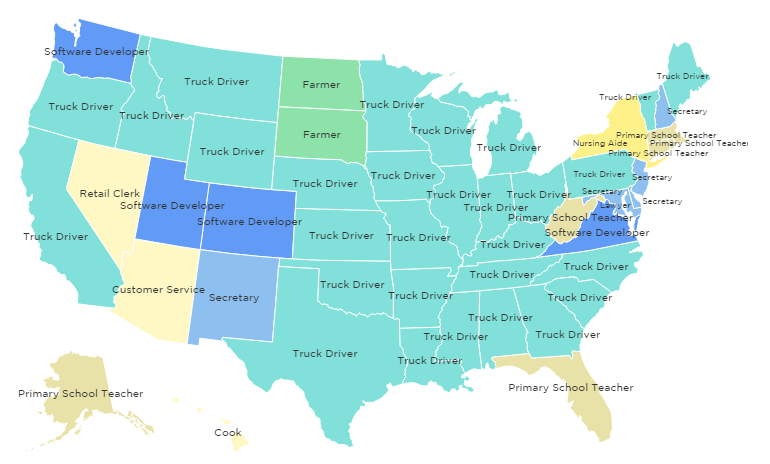
NPR’s graphic reveals that “truck driver” remains the most prevalent job in many U.S. states.
However, the profession has drastically changed over the years. In 1980, truckers earned the equivalent of approximately $110,000 per year, while today’s average earnings stand at around $40,000. What has led to this decline in what was once a stable American occupation?
Research Insights from Steve Viscelli
Sociologist Steve Viscelli, writing for the Atlantic, examines the evolving landscape of truck driving. He undertook an entry-level long-haul trucking position, conducted interviews with fellow workers, and analyzed the history of the industry. His findings suggest that the trucking sector has significantly reduced worker pay by converting drivers into independent contractors, misleading them about the advantages of this status, and enticing them into restrictive contracts.
Misunderstood Independence
Viscelli points out that many truckers initially lack a clear understanding of what being an independent contractor entails. While trucking firms promote the allure of self-employment and flexible hours, they fail to highlight that such arrangements involve heavier taxation, out-of-pocket expenses, and truck lease payments. He shares the story of one driver who, during one pay period, earned the equivalent of just 50 cents per hour; on another occasion, he found himself in debt to the company by $100. Viscelli asserts that independent contractors often work harder while receiving significantly lower pay than their employed counterparts.
Binding Contracts and Debt
Truckers face challenges when attempting to exit these contracts, as companies can leverage their truck leases to maintain control. Drivers often sign multi-year agreements to lease their trucks, accompanied by clauses that prevent them from seeking employment elsewhere. Violation of these contracts could result in tens of thousands of dollars in liabilities, making it financially unfeasible for truckers to leave. Consequently, many find themselves working not to earn a profit but simply to avoid falling into debt.
The Middle Class Decline
The deterioration of this traditionally middle-class job is part of a broader trend. When viewing all occupations that have lost their middle-class income potential, alongside the emergence of lower-paying positions, it contributes to the shrinking middle class. Since 1970, the percentage of Americans classified as middle-income has steadily declined, defined as households earning between two-thirds and double the median income.
Changing Economic Landscape
A significant factor in this trend is the transition from an industrial economy to one dominated by service-oriented (lower-paying) and knowledge-based (higher-paying) jobs. Simultaneously, work restructuring increasingly favors owners and investors over employees. While American worker productivity has risen, the associated benefits have predominantly benefitted employers, not the workers themselves.
Wage vs. Productivity Discrepancy
Data indicates that between 1948 and 1973, productivity and wages saw comparable increases (97% and 91%, respectively). However, from 1973 to 2014, productivity continued to rise (by 72%), while wages lagged significantly, increasing by only 9%. This disparity explains why many Americans today find it challenging to maintain a secure financial footing in an economy that makes achieving middle-class status increasingly difficult.
Lisa Wade, PhD is an Associate Professor at Tulane University. She is the author of American Hookup, a book about college sexual culture; a textbook about gender; and a forthcoming introductory text: Terrible Magnificent Sociology. You can follow her on Twitter and Instagram.
